
PCD vs PCBN: the practical difference
PCD and PCBN are both superhard cutting-tool materials, but they are designed for very different workpiece groups. PCD is generally selected for aluminum, other non-ferrous metals, composites, graphite and abrasive non-metal materials. PCBN is generally selected for hardened steel, cast iron and selected ferrous powder-metallurgy applications.
That material distinction should be the starting point for every PCD vs PCBN decision. Tool shape and purchase price matter, but neither can correct a cutting material that is fundamentally mismatched to the workpiece.
For buyers, the practical question is not which material is harder or more advanced. It is which cutting edge can deliver the required tool life, surface quality and process stability in the actual workpiece, operation and machine condition.
What are PCD cutting tools?
PCD stands for polycrystalline diamond. PCD cutting material is produced by sintering diamond particles into a dense cutting layer, often supported by a cemented-carbide substrate. The PCD cutting portion may be brazed or otherwise integrated into inserts, milling cutters, drills and custom tools.
Diamond provides very high abrasion resistance and can support a sharp cutting edge. Those characteristics make PCD cutting tools useful when machining non-ferrous or non-metallic materials that wear conventional carbide edges quickly or require consistent surface quality.
Common PCD tool forms include:
- PCD-tipped turning and boring inserts
- PCD face-milling inserts and milling cutters
- PCD drills and step drills
- PCD routers and tools for composite trimming
- Custom combination tools for multiple features
- Drawing-based PCD tools for repeat production
PCD grade, diamond grain structure, edge condition, tool geometry and support must still match the application. A PCD tool intended for finishing aluminum is not automatically the right choice for a heavily interrupted composite operation.
What are PCBN cutting tools?
PCBN stands for polycrystalline cubic boron nitride. PCBN cutting material combines CBN particles in a sintered structure, commonly with a binder system. It may be supplied as a tipped insert, multiple-corner insert or solid PCBN construction, depending on the geometry and application.
PCBN retains cutting capability in hard and abrasive ferrous applications where PCD is normally not selected. It is widely considered for hard turning, cast-iron machining and certain powder-metallurgy materials.
Common PCBN tool forms include:
- ISO-style PCBN turning inserts
- Tipped or solid PCBN inserts
- PCBN boring and grooving tools
- PCBN milling inserts for suitable cast-iron or hardened-material applications
- Custom PCBN inserts with application-specific edge preparation
- Non-standard PCBN tools based on drawings or current samples
PCBN grades vary in CBN content, binder, grain structure, coating and intended balance of wear resistance and toughness. The correct choice depends on hardness, continuous or interrupted cutting, allowance, finish target and machine stability.
PCD vs PCBN comparison table
The website uses a simplified comparison format so the information remains readable on desktop and mobile.
- Cutting material: PCD uses polycrystalline diamond; PCBN uses polycrystalline cubic boron nitride.
- Primary workpiece group: PCD is mainly for non-ferrous and abrasive non-metal materials; PCBN is mainly for hardened ferrous materials, cast iron and selected ferrous powder metals.
- Typical applications: PCD is common in aluminum finishing, non-ferrous machining and composite cutting; PCBN is common in hard turning, cast-iron machining and selected hard finishing.
- Cutting-edge priority: PCD selection often emphasizes edge sharpness, wear resistance and surface quality; PCBN selection often balances hot hardness, wear resistance and resistance to chipping.
- Interrupted cutting: Both require application review; PCD geometry must suit abrasive and layered materials, while PCBN grade and edge preparation must match interruption severity.
- Main buyer input: PCD selection starts with exact non-ferrous or composite material details; PCBN selection requires material designation, hardness and cut continuity.
- Economic comparison: Both should be judged by cost per acceptable part rather than unit price alone.
This is a general selection map, not a substitute for application review. Material grade, structure, operation and production conditions can create exceptions.
Materials suitable for PCD cutting tools
PCD tools are commonly evaluated for the following material groups.
- Aluminum and aluminum alloys: PCD inserts, milling cutters and drills are often used for repeat machining where edge wear, built-up material, finish and dimensional consistency need to be controlled.
- Copper, brass and other non-ferrous metals: A sharp PCD edge can be useful for precision turning, boring or milling when surface quality is important.
- CFRP and GFRP composites: PCD tools may be considered for abrasive fiber-reinforced materials, but geometry must address delamination, fiber pull-out, burrs and edge damage.
- Graphite: The abrasive nature of graphite can make PCD useful in suitable milling and profiling applications, with dust control and machine protection reviewed separately.
- Abrasive plastics and filled materials: PCD may be appropriate when fillers or fibers produce rapid carbide wear.
- Aluminum-composite stacks: These require careful geometry and process review because the cutting edge encounters materials with different behavior.
The exact alloy, silicon content, reinforcement, fiber direction, laminate construction and workpiece thickness can influence tool choice. Buyers should provide more than the word aluminum or composite when requesting a recommendation.
Why PCD is generally avoided in hot ferrous cutting
PCD is generally not selected for conventional machining of steel and other iron-rich materials at elevated cutting temperatures. Diamond is carbon, and under hot ferrous cutting conditions the cutting edge can interact chemically with iron, accelerating edge wear and degrading performance.
This is why the material-selection map normally directs buyers toward carbide, ceramic or PCBN options for steel, depending on hardness, operation and cutting conditions. It does not mean that every non-ferrous application automatically needs PCD or that every steel application automatically needs PCBN.
PCD can appear in specialized material systems and non-cutting wear applications that include ferrous materials. Those exceptions should not be treated as general permission to use standard PCD cutting tools for hot steel machining.
Materials suitable for PCBN cutting tools
PCBN tools are commonly evaluated for these workpiece groups.
- Hardened steel: Bearing steel, tool steel, hardened gears, shafts and transmission parts are common hard-turning applications when material hardness and heat-treatment condition are known.
- Gray cast iron: PCBN may be used for abrasive cast-iron turning or milling when the grade and cutting conditions suit the operation.
- Brake discs and brake drums: These repeat-production cast-iron applications can require careful control of surface quality, dimensional stability and cost per part.
- Ferrous powder-metallurgy materials: Porosity, interrupted edge contact and abrasive constituents can influence grade and edge preparation.
- Chilled or hard cast materials: Suitability depends on the exact structure, hardness and operation.
- Selected hard-facing and wear-resistant materials: These require supplier review because composition and machinability vary widely.
PCBN should not be treated as a general replacement for carbide in all steel machining. For softer steel, stainless steel and many general operations, coated carbide or another tool material may remain more practical. PCBN becomes more relevant when hardness, abrasion and cutting temperature justify a superhard edge.
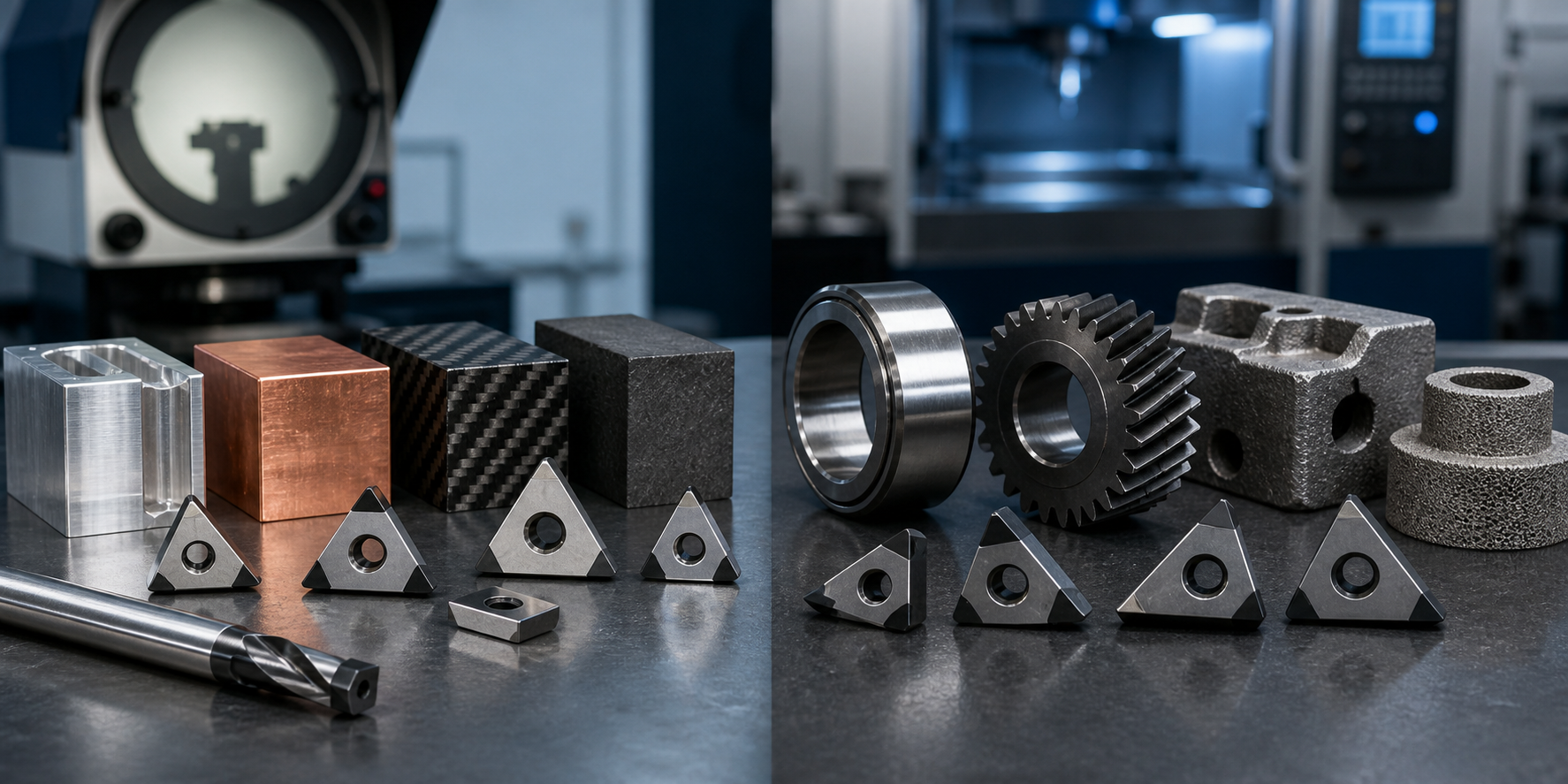
If you machine this, consider that
Use the following as a first selection direction before detailed tool review.
- Aluminum housings or automotive aluminum parts: Consider PCD when production volume, finish requirements or abrasive alloy content justify it.
- Copper, brass or non-ferrous precision components: Consider PCD when a sharp edge and consistent finish are important.
- CFRP, GFRP or abrasive composites: Consider PCD or a suitable diamond-based solution after confirming laminate construction, thickness and quality risks.
- Graphite electrodes or abrasive graphite parts: Consider PCD for suitable operations when wear control and dust management are addressed.
- Hardened bearing rings, gears or shafts: Consider PCBN after confirming material grade, heat treatment, hardness range and allowance.
- Gray cast-iron automotive components: Consider PCBN when the grade and geometry match the cast-iron type and operation.
- Ferrous powder-metal parts: Consider PCBN only after confirming density, porosity, composition, hardness and interruption level.
- General unhardened steel or stainless steel: Start by reviewing carbide or another suitable tool material rather than assuming PCBN is required.
This first choice must then be checked against the operation. Turning, milling, drilling, boring and grooving load the cutting edge differently, even in the same workpiece material.
What buyers should confirm before selecting PCD or PCBN
A useful quotation request should include enough information to identify both material fit and process risk.
- Workpiece material: Provide the complete alloy, grade or composite designation, not only a broad family name.
- Material hardness: Include the measured range and scale, especially for hardened steel and powder-metal parts.
- Machining operation: State turning, milling, drilling, boring, grooving, trimming or another process.
- Cut continuity: Describe continuous, light-interrupted or heavy-interrupted cutting, including holes, keyways, splines, scale or uneven stock.
- Allowance and depth of cut: State the actual range rather than only a nominal value.
- Surface-finish requirement: Provide the measurement type and units, plus any dimensional or edge-quality limits.
- Tool-life expectation: Define the endpoint as parts, cutting time, wear, finish loss or dimensional drift.
- Machine condition: Include machine model, spindle condition, holder, overhang, workholding and known rigidity limits.
- Coolant and chip control: Describe dry or wet machining, coolant delivery, dust extraction and chip evacuation where relevant.
- Existing tool problem: Explain wear, chipping, built-up material, delamination, burrs, poor finish, unstable size or unexpected breakage.
- Current tool: Send the complete model, grade, edge preparation, drawing or clear photographs.
- Purchasing volume: Include trial quantity, monthly or annual consumption and required delivery schedule.
For custom tools, a dimensioned drawing and tolerance information are essential. For replacement inserts, the holder model and all characters of the insert designation help prevent geometry errors.
Continuous and interrupted cutting matter
Cut continuity changes how a superhard edge should be supported. A stable continuous finishing cut may allow the selection process to emphasize wear resistance and finish. Interrupted cutting repeatedly loads and unloads the edge, increasing the importance of toughness, edge preparation, insert support and machine rigidity.
For PCBN, distinguish a shallow cross-hole from a wide keyway or multiple heavy interruptions. For PCD in composites, identify layered construction, entry and exit conditions, unsupported edges and changes in fiber direction.
Do not describe an operation only as interrupted. A part drawing or clear photo showing the interruption allows the supplier to judge severity and propose a more relevant trial direction.
Surface finish and tool-life expectations
Surface finish depends on the complete system: tool material, edge quality, geometry, nose radius, feed, machine condition, workholding and wear progression. A superhard tool cannot compensate for excessive runout, poor clamping or unstable stock.
Define tool life with a shared endpoint. One supplier may report parts until the insert is indexed, while another may stop when a finish or size limit is reached. Without the same endpoint, the numbers are not comparable.
During a trial, record wear pattern, surface quality, dimensions and parts per edge. Change one major variable at a time so the effect of tool material, grade or geometry can be understood.
Lowest tool price versus lowest machining cost
PCD and PCBN tools often have a higher purchase price than conventional carbide alternatives. That price must be evaluated beside production value.
Buyers should compare:
- Usable cutting edges and parts per edge
- Cycle time at stable cutting conditions
- Tool-change and offset-adjustment time
- Surface finish and dimensional consistency
- Scrap, rework and inspection burden
- Unplanned downtime and breakage risk
- Repeatability across tool batches
- Regrinding or retipping options when applicable
- Delivered cost, lead time and inventory requirements
The useful purchasing measure is cost per acceptable finished part. A lower-priced tool can be more expensive if it requires frequent changes or creates unstable quality. A higher-priced PCD or PCBN tool is valuable only when the application and verified production results support the total cost.
Related Sereno buyer guides
This article complements the existing Sereno guides PCD vs Carbide: Key Differences for Buyers, How to Choose PCBN Inserts for Hardened Steel, PCD Tools for Aluminum Machining, and PCD Drills for CFRP and Composite Materials. These guides provide deeper application-specific questions for buyers reviewing those material groups.
Information to send Sereno
To request a PCD or PCBN tooling direction, send Sereno Cutting Tools the workpiece material, hardness, machining operation, current insert or tool, current failure mode, tool-life target, surface-finish requirement, trial quantity and annual consumption.
Sereno supports standard PCD and PCBN inserts, custom PCD and PCBN inserts, milling tools and non-standard tools. Recommendations should begin with application information, not an unsupported performance promise.
Buyer takeaway
PCD vs PCBN is primarily a material-selection decision. PCD belongs mainly with aluminum, non-ferrous metals, composites, graphite and abrasive non-metal materials. PCBN belongs mainly with hardened steel, cast iron and selected ferrous powder-metal applications.
After confirming the material family, buyers should compare grade direction, geometry, edge preparation, operation, cut continuity, finish, machine condition and cost per finished part. Complete application data gives suppliers the best chance to recommend a practical trial and quotation path.