
Overview
PCBN inserts and ceramic inserts are both used in demanding machining applications, especially when ordinary carbide inserts cannot provide enough tool life, heat resistance or stable cutting performance.
For buyers, the important point is simple: PCBN and ceramic inserts are not the same product. They may be used in some similar applications, but the best choice depends on workpiece material, hardness, cutting condition, surface finish requirement and production stability target.
This article explains the main differences in practical buyer language, so purchasing teams can prepare better information before requesting a quotation.
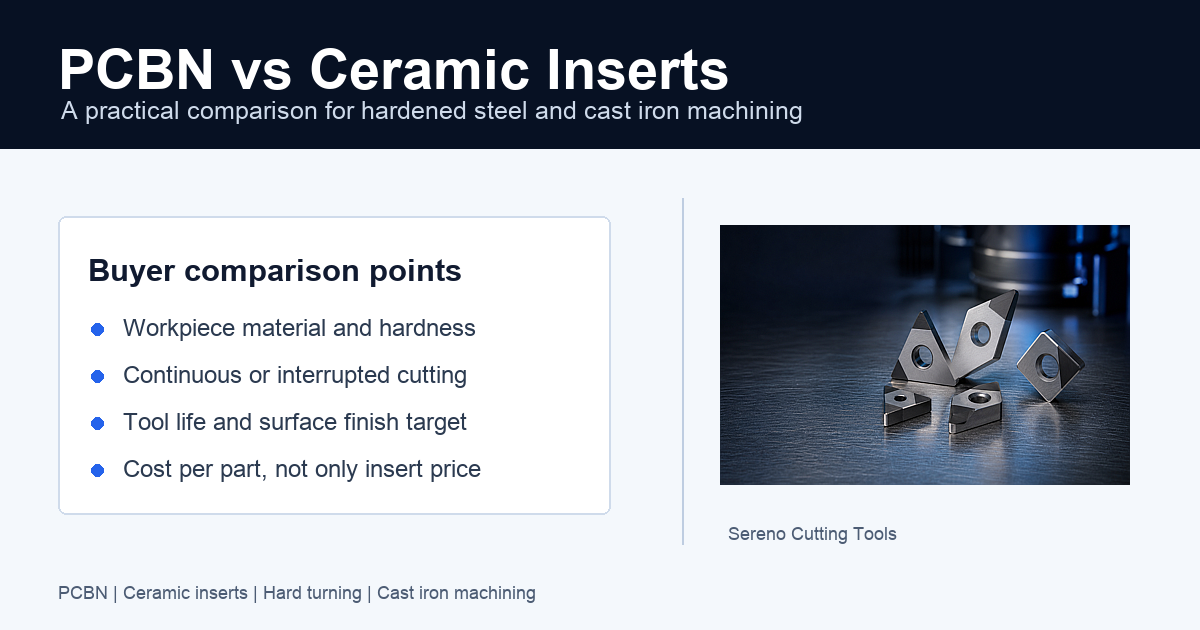
What are PCBN inserts?
PCBN stands for polycrystalline cubic boron nitride. PCBN inserts are usually selected for hard materials and abrasive cutting conditions where edge stability and heat resistance are important.
Typical PCBN applications include:
- Hardened steel parts after heat treatment
- Bearing rings and bearing components
- Gears, shafts and transmission parts
- Cast iron parts
- Brake discs and brake drums
- Powder metallurgy parts
- Continuous, interrupted or semi-interrupted hard turning
PCBN is often considered when buyers need better tool life, more stable size control or improved surface finish in hard turning and cast iron machining.
What are ceramic inserts?
Ceramic inserts are also used in high-temperature and high-speed machining applications. They are commonly used for some cast iron, hardened steel and heat-resistant alloy applications, depending on the ceramic grade and cutting condition.
Typical ceramic insert applications may include:
- High-speed turning
- Cast iron machining
- Some hardened steel finishing
- Heat-resistant alloy machining in selected conditions
- Continuous cutting where the machine and workholding are stable
Ceramic inserts can be cost-effective in the right application, but they are often more sensitive to impact, machine vibration and unstable cutting conditions.
Main differences between PCBN and ceramic inserts
Both products can handle difficult machining, but buyers should compare them by application, not only by insert price.
- Tool material: PCBN is based on cubic boron nitride. Ceramic inserts are based on ceramic materials such as alumina, silicon nitride or mixed ceramic systems.
- Typical strength: PCBN is often selected for hard turning, cast iron and abrasive cutting where stable edge performance is required.
- Typical sensitivity: ceramic inserts may perform well in stable high-speed cutting, but can be more sensitive to interrupted cuts or unstable setups.
- Cost structure: PCBN usually has a higher unit price, but may reduce cost per part in suitable applications.
- Selection logic: ceramic inserts may be practical for some stable and high-speed applications, while PCBN is often reviewed when tool life, edge stability and repeat performance are more important.
The better question is not “Which insert is cheaper?” The better question is “Which insert gives the most stable cost per part in this machining condition?”
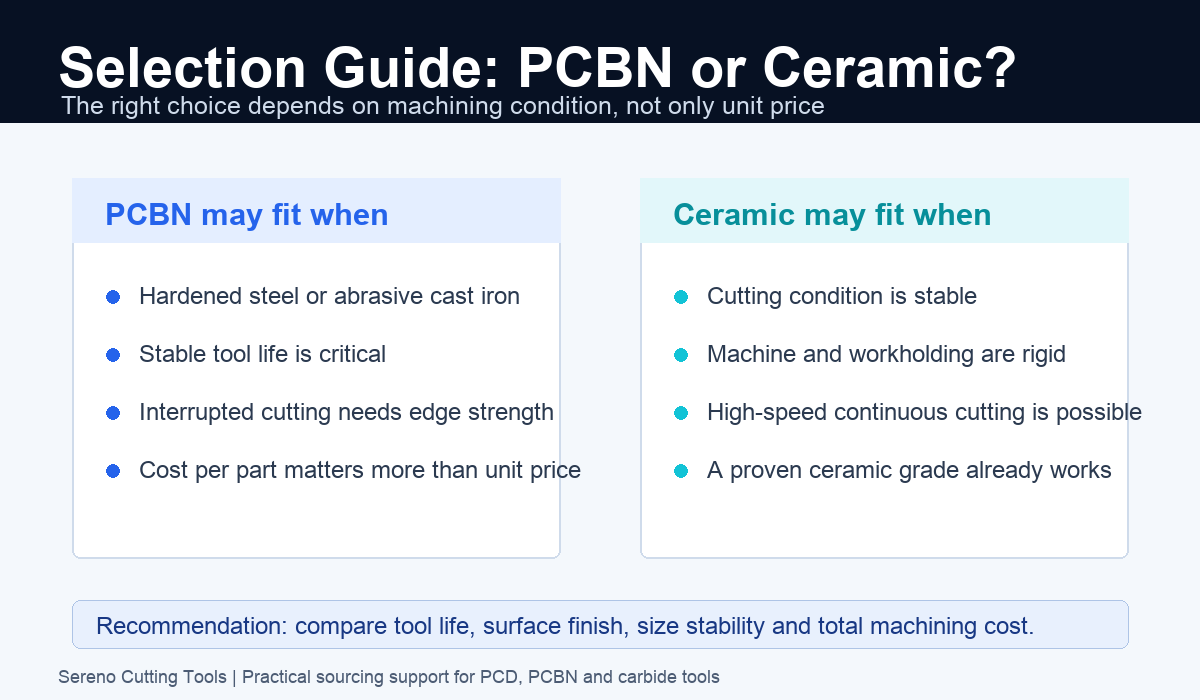
When PCBN may be a better choice
PCBN inserts may be worth reviewing when the workpiece is hard, abrasive or difficult to machine consistently.
Buyers usually consider PCBN when they face these problems:
- Carbide inserts wear too quickly
- Tool life changes too much between batches
- Surface finish is unstable
- Insert chipping appears in interrupted cutting
- Part size changes during production
- Tool change frequency is too high
- The buyer wants to reduce cost per part, not only insert price
For hardened steel, the workpiece hardness is very important. Buyers should provide HRC value if available. For cast iron and brake disc machining, production volume, surface finish and tool life target are also important.
When ceramic inserts may be practical
Ceramic inserts may be practical when the machining condition is stable and the cutting speed is suitable.
Buyers may consider ceramic inserts when:
- The operation is stable and continuous
- The machine has good rigidity
- The workholding is strong
- The application supports high cutting speed
- The target is productivity in a suitable material
- The buyer already has a proven ceramic grade or current ceramic insert model
However, ceramic inserts should be reviewed carefully if the cut is heavily interrupted, the setup is unstable or the workpiece surface condition changes frequently.
Buyer checklist before quotation
To compare PCBN and ceramic inserts properly, buyers should prepare technical information before asking for price.
Important information includes:
- Workpiece material: steel grade, cast iron type or alloy type.
- Hardness: especially HRC value for hardened steel.
- Operation type: turning, boring, facing, grooving or finishing.
- Cutting condition: continuous, interrupted or semi-interrupted cutting.
- Current insert model: existing PCBN, ceramic or carbide insert model if available.
- Current tool life: how many pieces or minutes the current insert can machine.
- Main problem: wear, chipping, poor surface finish, unstable size or high cost.
- Surface finish target: Ra value or customer quality requirement if available.
- Quantity demand: trial quantity, monthly demand and annual demand.
- Machine condition: machine rigidity, coolant condition and cutting speed if known.
Good information helps suppliers recommend a more practical insert direction and avoid unnecessary trial cost.
Practical comparison table
| Buyer question | PCBN inserts | Ceramic inserts | | --- | --- | --- | | Common use | Hardened steel, cast iron, brake discs, bearings | Stable high-speed cutting, cast iron, selected hard materials | | Tool life target | Often used when repeat tool life is important | Can be good in stable applications | | Interrupted cutting | Possible with correct grade and edge preparation | Needs careful review | | Unit price | Usually higher | Often lower than PCBN | | Best comparison method | Cost per part, stability and tool life | Productivity and suitable cutting condition |
Sereno buyer support
Sereno Cutting Tools supports buyers who need PCBN inserts, custom PCBN inserts and PCD/PCBN non-standard tools. We can help review drawings, current insert models, workpiece materials and machining problems before quotation.
If you are not sure whether PCBN or ceramic inserts are more suitable, send your current tool model, material, hardness, quantity and machining problem. We will review your request and help prepare a practical quotation path.
Buyer takeaway
PCBN inserts and ceramic inserts can both be useful, but they should not be selected only by price. For professional buyers, the more useful comparison is total machining cost, including tool life, surface finish, size stability, tool change time and scrap risk.
For demanding hardened steel, cast iron and brake disc applications, PCBN may provide stronger repeat performance when selected correctly. For stable high-speed cutting, ceramic inserts may also be practical. The right choice depends on the real application.