
Overview
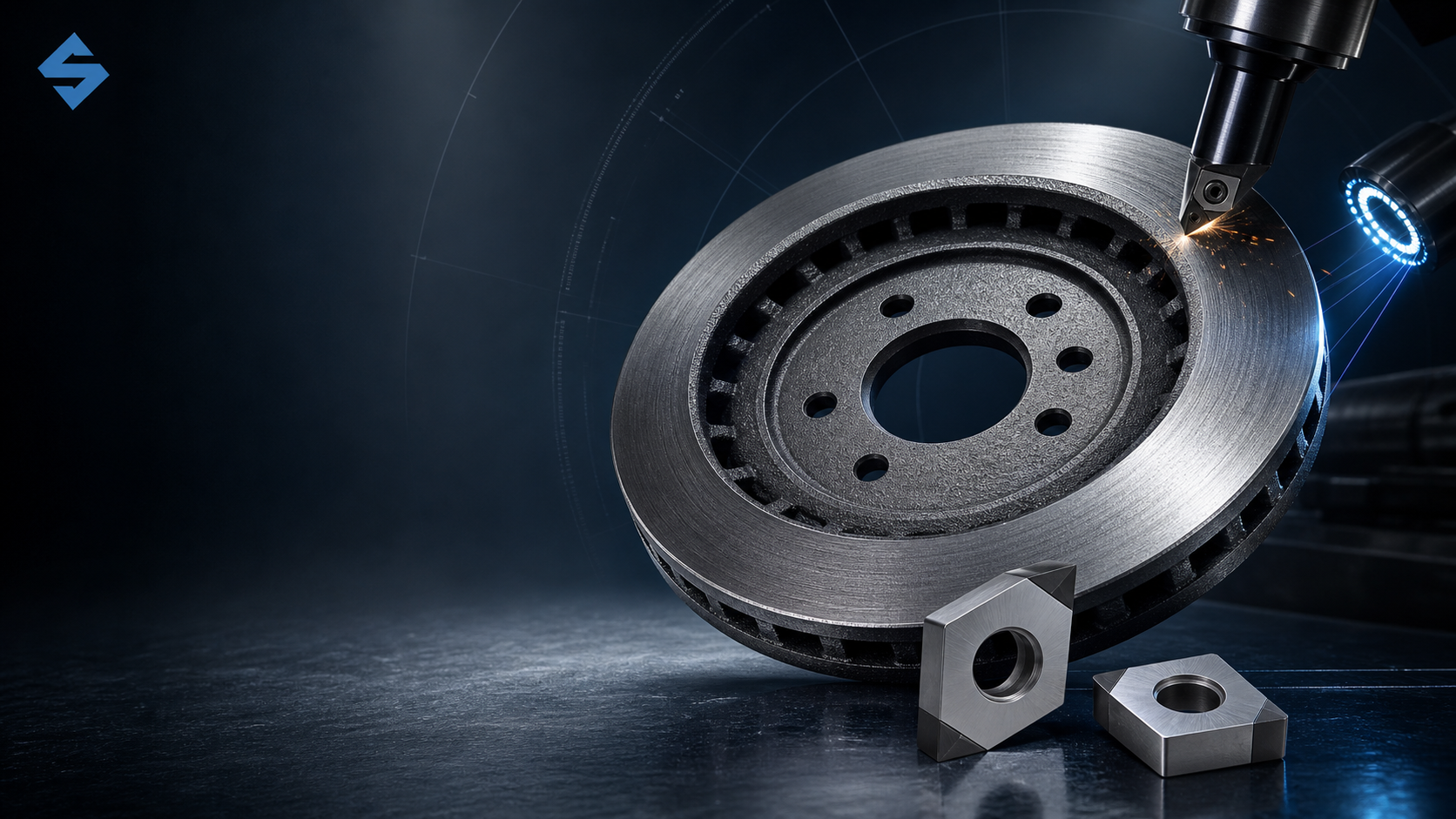
PCBN inserts are often considered for cast iron parts and brake disc machining when buyers need stable tool life, reliable surface finish and repeatable production performance.
For purchasing teams, the important point is not only whether PCBN is “hard enough.” The real question is whether the PCBN grade, edge preparation, insert geometry and machining condition match the actual application.
In automotive and industrial machining, cast iron can be abrasive. Brake discs and brake drums also require stable surface quality and dimensional consistency. In these applications, a low insert price is not always the best buying decision. Tool life, tool change time, scrap risk and production stability should be reviewed together.
Why PCBN is used for cast iron machining
Cast iron machining can create strong wear on cutting edges, especially in repeat production. Depending on the cast iron type, surface condition and cutting parameters, ordinary carbide inserts may wear quickly or create unstable surface finish.
PCBN can be useful when the buyer is trying to improve:
- Tool life: fewer insert changes during repeat production.
- Surface finish: more consistent machined surface over longer cutting time.
- Dimensional stability: better control when the same part is produced in batches.
- Productivity: higher cutting speed or more stable cycle time in suitable applications.
- Cost per part: a more practical cost measurement than insert price alone.
This does not mean PCBN is always the right choice for every cast iron job. Some cast iron applications can still be handled well by carbide or ceramic inserts. PCBN should be selected when the actual machining condition justifies the material.
Brake disc machining requirements
Brake disc machining is a typical application where buyers often care about both performance and consistency. The machined surface needs to be stable, and the tool should perform predictably during continuous production.
Common buyer concerns include:
- Stable tool life: the tool should not fail unexpectedly during production.
- Surface finish: the brake disc surface must meet the required quality standard.
- Dimensional consistency: part size should remain stable across the production batch.
- Edge reliability: chipping or sudden edge failure can create scrap and downtime.
- Cycle time: production speed matters when the part volume is high.
- Tool cost per part: buyers should compare total machining cost, not only insert unit price.
For brake discs, the best insert choice depends on the cast iron grade, machine condition, cutting operation and finish target. A supplier cannot recommend the right PCBN insert only from the words “brake disc.” More application details are needed.
Key information buyers should prepare
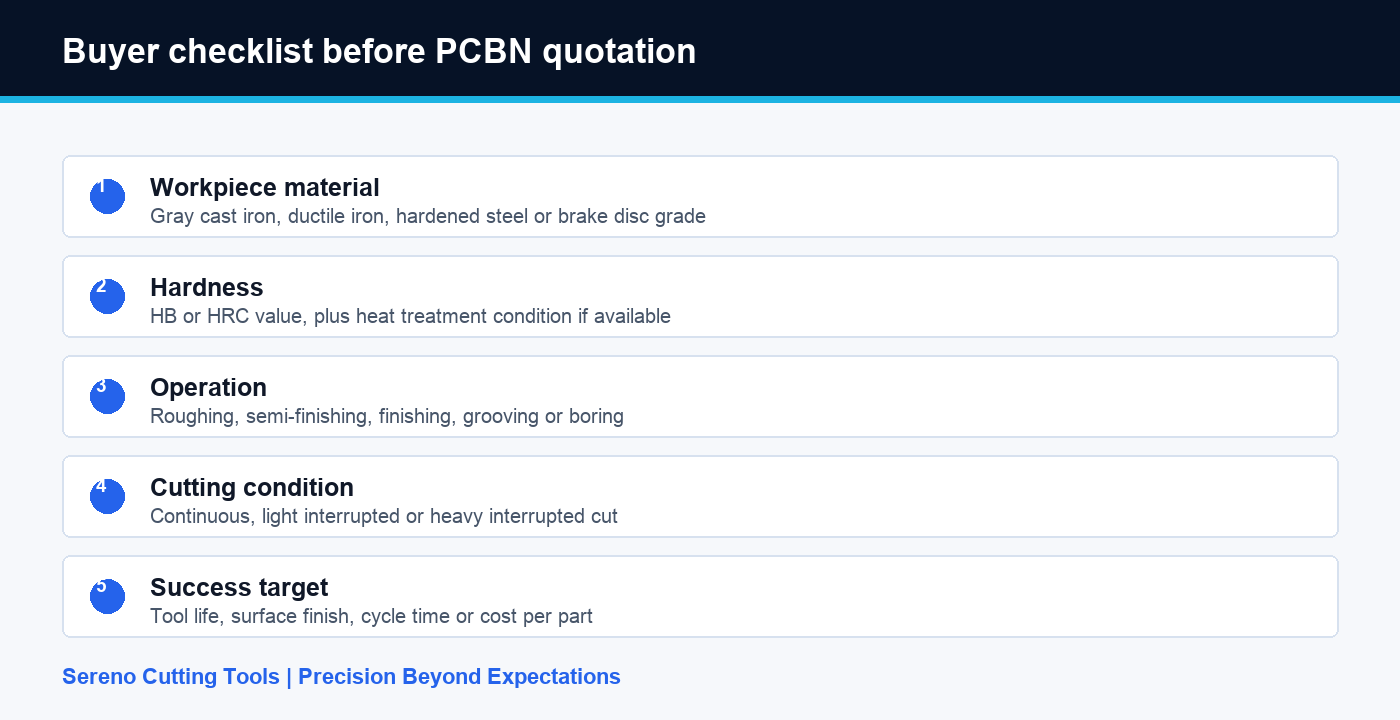
Before requesting a PCBN quotation, buyers should prepare the information below. Even if some details are not available, sharing what you already know will make the first review more practical.
- Workpiece material: gray cast iron, ductile iron, hardened steel or another material.
- Hardness: HB or HRC value if available.
- Part type: brake disc, brake drum, bearing component, pump part or general cast iron component.
- Operation: roughing, semi-finishing, finishing, boring, grooving or facing.
- Cutting condition: continuous, light interrupted, semi-interrupted or heavy interrupted cutting.
- Machine condition: CNC lathe, machining center, rigidity and general stability.
- Current insert model: ISO code, grade, nose radius and chipbreaker if known.
- Current problem: short tool life, chipping, poor finish, unstable size or high cost per part.
- Target result: expected tool life, finish requirement, cycle time or cost target.
- Quantity: trial order quantity, monthly demand or annual demand.
For custom PCBN inserts, drawings and sample photos are especially helpful. They help confirm insert shape, dimensions, tolerance and edge requirement before quotation.
PCBN grade and edge preparation
PCBN performance depends heavily on grade direction and edge preparation. Two PCBN inserts that look similar may perform very differently if the grade, CBN content, binder system, edge hone or chamfer design is different.
For cast iron and brake disc applications, suppliers usually need to understand whether the cut is smooth and continuous or whether the insert will meet holes, slots, scale or interrupted surfaces. This affects how strong the cutting edge needs to be.
In simple buyer language:
- Continuous cutting: may allow a sharper or more productivity-focused edge.
- Interrupted cutting: may require stronger edge preparation to reduce chipping risk.
- Finishing operation: surface finish and dimensional control become more important.
- Roughing operation: edge strength and heat resistance become more important.
This is why a quotation should not only list “PCBN insert price.” A professional quotation should also consider application fit.
PCBN vs carbide and ceramic inserts
Carbide inserts are still widely used for many cast iron applications. Ceramic inserts can also be suitable for some high-speed machining jobs. PCBN should be considered when the buyer needs higher wear resistance, better tool life stability or better performance in a demanding condition.
A practical comparison is:
- Carbide inserts: often practical for general machining and lower-cost applications.
- Ceramic inserts: can be suitable for certain high-speed cast iron or hard material operations.
- PCBN inserts: often considered for demanding cast iron, brake disc, hardened steel and repeat-production machining.
The best choice depends on the real machining target. If the current carbide or ceramic insert already meets tool life, finish and cost target, PCBN may not be necessary. If the current tool creates frequent changes, unstable finish or high scrap risk, PCBN may be worth testing.
How to compare cost correctly
For PCBN inserts, buyers should avoid comparing only unit price. PCBN usually costs more per insert than carbide, but the real question is whether it can reduce total machining cost.
Buyers should compare:
- Insert price
- Tool life
- Number of parts per cutting edge
- Tool change time
- Machine downtime
- Surface finish stability
- Scrap risk
- Production consistency
For example, if a cheaper insert requires frequent changes and creates unstable quality, the actual cost may be higher. If a PCBN insert runs longer and keeps the part stable, it may be more economical in repeat production.
When custom PCBN inserts are needed
Standard PCBN inserts are suitable when the buyer already has a clear ISO model and common application. However, custom PCBN inserts may be needed when the tool shape, edge structure or machining target is not standard.
Custom PCBN inserts are often reviewed for:
- Special insert shape or size
- Replacement of an existing non-standard insert
- Special edge preparation for interrupted cutting
- Boring, grooving or profiling applications
- Application-specific surface finish improvement
- High-volume repeat production where tool life stability matters
For custom tools, the buyer should provide drawings, photos, current tool model and application notes. This helps reduce quotation mistakes and shortens the review process.
Practical quotation checklist
Before sending an inquiry, buyers can use this simple checklist:
- What material is being machined?
- What is the hardness?
- What is the part name and application?
- Is the operation roughing, finishing, boring or grooving?
- Is the cutting condition continuous or interrupted?
- What insert or tool is currently used?
- What problem needs to be improved?
- What result would make the test successful?
- What is the expected monthly or annual demand?
- Do you need only product price, or delivered price including freight?
The more clearly these points are provided, the easier it is to prepare a practical quotation.
How Sereno supports buyers
Sereno Cutting Tools supports buyers with standard PCBN inserts, custom PCBN inserts and PCD/PCBN non-standard cutting tools. For cast iron and brake disc machining projects, we focus on understanding the application before quoting.
If you are sourcing PCBN inserts for brake discs, brake drums, cast iron parts or hardened components, please send your current insert model, drawing, material, hardness, quantity and machining problem. We will review your request and reply with a practical quotation path.
Buyer takeaway
PCBN inserts can be a strong option for cast iron and brake disc machining, but the correct selection depends on the actual production condition.
For buyers, the best starting point is not simply asking “How much is this insert?” A better question is: “Which PCBN insert can help us improve tool life, surface finish, stability and cost per part in this application?”