
Start with the machining application, not the insert price
Choosing PCBN inserts for hardened steel is an application-matching decision. Two inserts with the same ISO shape can behave very differently when the workpiece hardness, interruption level, edge preparation or machine condition changes.
For a buyer, the practical goal is not to find the hardest insert or the lowest unit price. It is to select an insert that can hold the required tolerance and surface finish for a predictable number of parts, without unacceptable chipping, wear or process variation.
A useful selection process begins with seven questions:
- What is the exact workpiece material and heat-treatment condition?
- What is the measured hardness range?
- Is the cut continuous, lightly interrupted or heavily interrupted?
- Is the operation finishing, semi-finishing or stock removal?
- What tolerance and surface-finish target must be maintained?
- What cutting conditions, holder and machine setup are in use?
- How does the current insert fail, and what tool-life target matters?
These details give a PCBN supplier enough context to recommend a grade direction, insert structure and edge preparation instead of quoting by insert shape alone.
Confirm the hardened steel and hardness range
Start with the complete workpiece designation whenever possible. Bearing steel, tool steel, case-hardened alloy steel and through-hardened components may all be described as hardened steel, but their composition, microstructure, hard layer depth and machining behavior are not identical.
Provide the measured hardness as a range, not only a nominal value. Also identify whether the hardness is uniform through the part or limited to a case-hardened surface. A tool may enter a hard layer, cross a softer core or encounter hardness variation from part to part. That variation affects cutting forces, heat generation and edge stability.
PCBN is commonly evaluated for high-hardness turning applications, but hardness alone does not prove that a specific grade will work. Material condition, scale, inclusions, residual stress and depth-of-cut variation must also be reviewed. If hardness is uncertain, send the heat-treatment specification and recent measurement data with the RFQ.
Classify the cut as continuous or interrupted
Cut continuity is one of the most important selection factors because interruption repeatedly loads and unloads the cutting edge.
- Continuous cutting keeps the edge engaged with relatively steady load. It generally allows the selection process to emphasize wear resistance, dimensional control and finish stability.
- Lightly interrupted cutting includes small cross-holes, shallow keyways or short gaps. The edge needs more resistance to impact while still controlling wear.
- Heavily interrupted cutting includes wide keyways, splines, uneven stock, multiple holes or unstable entry and exit. Edge strength, insert support and machine rigidity become more important.
Describe the interruption physically rather than using only the word interrupted. Include a part drawing or photo showing the number, width and position of gaps. State whether the insert enters the gap at full depth and whether the cut has scale or variable stock. This helps the supplier judge the severity instead of guessing.
An insert direction optimized for continuous finishing may be too brittle for a severe interruption. Conversely, a tougher selection and stronger edge preparation may create higher cutting forces than necessary in a stable continuous finishing operation.
Match PCBN grade characteristics to the failure risk
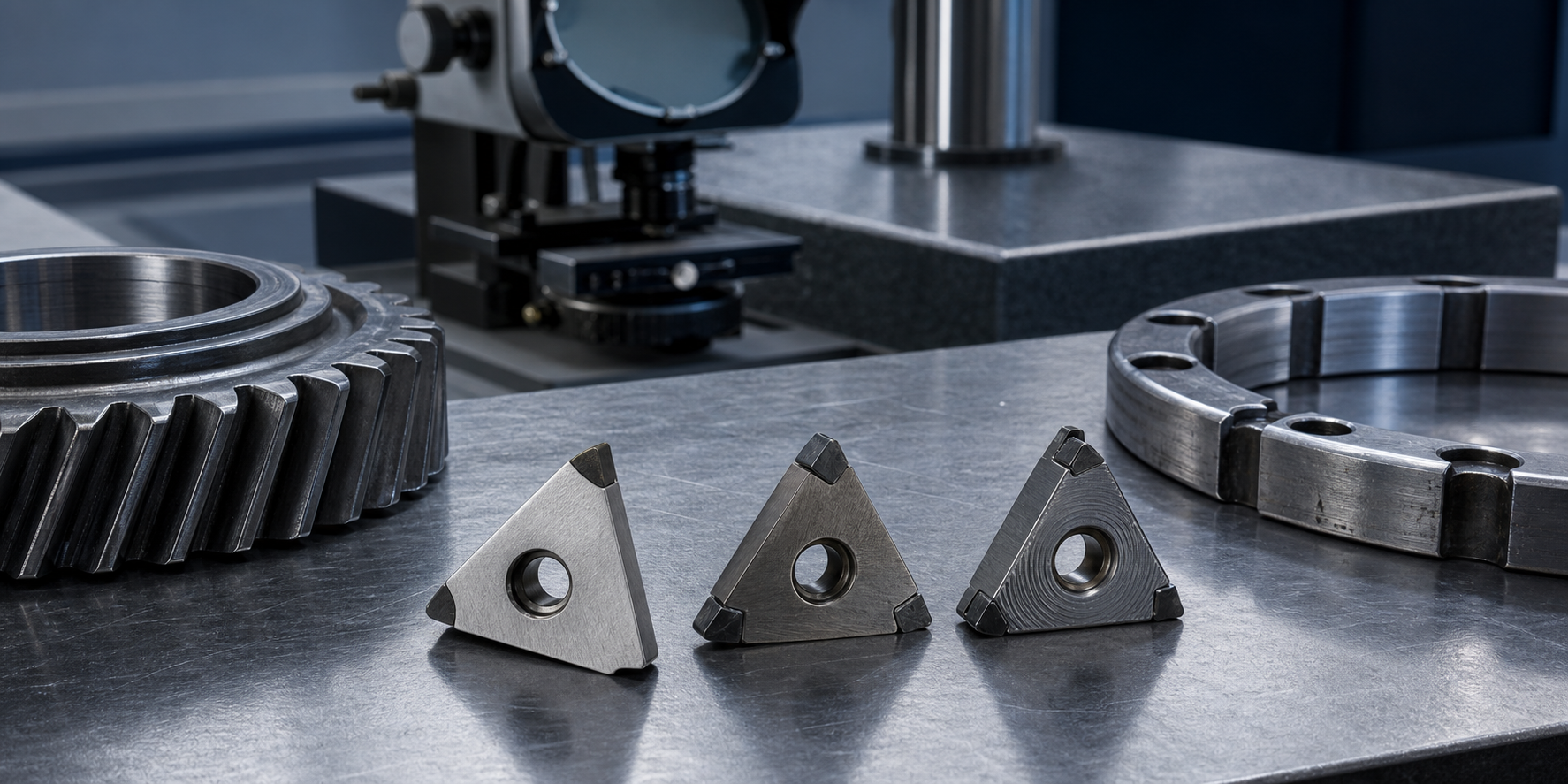
PCBN grades differ in CBN content, binder system, grain structure, coating and intended application range. Grade names are supplier-specific, so buyers should compare application characteristics rather than assuming that two grades with similar labels are equivalent.
As a general selection tendency, PCBN grades designed around higher toughness are considered when interruption or chipping risk is significant. Grades designed around wear resistance and thermal stability are often evaluated for continuous hard finishing. This is not a universal rule: the complete grade design, edge preparation and cutting conditions determine the result.
Ask the supplier to explain the proposed grade in practical terms:
- Is it intended for continuous, light-interrupted or heavy-interrupted hard turning?
- Does the recommendation prioritize wear resistance, toughness or a balance of both?
- Is the grade coated or uncoated, and what application reason supports that choice?
- What edge preparation is recommended with the grade?
- What operating window should be used for the first controlled trial?
Avoid approving a grade only because it is described as premium or general purpose. The recommendation should connect directly to the workpiece, cut type, finish target and current failure mode.
Select the insert structure and geometry
PCBN inserts may use a tipped construction, multiple cutting tips or a solid PCBN structure. Availability and economic fit depend on insert shape, edge access, depth of cut and application severity.
For a standard holder, provide the full ISO insert designation and the holder model. The insert shape, clearance angle, tolerance class, thickness, hole style and nose radius must match the setup. A partial model or a photo alone can lead to a quotation for the wrong geometry.
Nose radius affects both edge strength and the relationship between feed and theoretical surface finish. A larger radius can support the edge, but it can also increase radial cutting force and aggravate vibration on a less rigid setup. A smaller radius may reduce cutting force but provides less edge support. The choice must fit the component geometry, allowance, finish requirement and machine rigidity.
Standard PCBN inserts are the fastest quotation path when the ISO model and application are known. Custom PCBN inserts may be appropriate when the holder, accessible cutting edges, special geometry or edge treatment cannot be met by a standard option. Drawing-based review is important for any custom request.
Specify edge preparation instead of treating it as a detail
The PCBN cutting edge may be sharp, honed, chamfered or prepared with a combination of chamfer and hone. Edge preparation changes edge strength, cutting force, heat distribution and finish behavior.
- A light preparation can help limit cutting force in stable finishing, but it offers less protection against impact.
- A stronger chamfer or hone can support the edge in more demanding cuts, but it normally raises cutting forces.
- Chamfer angle and width should be specified when known; the word chamfered is not enough for exact replacement work.
- Edge consistency matters when a process must hold finish and dimensions across repeated batches.
If the current insert chips at entry or exit, do not assume that a tougher grade alone is the answer. The edge preparation, tool overhang, holder condition, part clamping, entry method and interruption severity should be reviewed together.
Connect finishing requirements to the full setup
State the required surface finish using the customer’s actual measurement and units, such as Ra or Rz. Include dimensional tolerance, roundness requirements and whether finish must be held throughout the planned tool-life interval.
A wiper-style geometry may support a higher feed at a given finish level in a suitable stable application, but it is not an automatic upgrade. Wiper orientation, holder alignment, machine rigidity and component shape must be compatible. For conventional nose radii, feed, radius, edge condition and vibration all affect the machined surface.
When finish deteriorates, document what changes first. A gradual finish decline may point toward wear or process drift, while sudden scratches or chatter marks may indicate chipping, built-up material, vibration or chip interference. Photos of the machined surface and a simple tool-life trend are more useful than describing the finish only as poor.
Establish cutting conditions with a controlled trial
Cutting speed, feed and depth of cut must be evaluated as a set. Published data from any supplier should be treated as a starting range for that specific grade and application, not as a universal PCBN value.
For the RFQ and trial plan, provide:
- Workpiece diameter at the cut and spindle-speed limits
- Current cutting speed or spindle speed
- Feed per revolution
- Radial depth of cut and actual stock variation
- Cut length and cycle time
- Dry, wet or minimum-quantity lubrication condition
- Coolant type, concentration, delivery and whether flow is continuous
- Machine model, spindle condition and any known rigidity limitation
- Holder model, tool overhang and insert clamping method
Avoid changing grade, edge preparation and multiple cutting parameters at the same time. A controlled trial changes one major variable at a time, uses comparable parts and records the result. This makes it possible to identify why performance changed.
Coolant strategy should remain consistent. Intermittent or poorly directed coolant can produce thermal cycling at the edge. If production must run wet, reproduce the actual coolant delivery during the trial rather than testing under an easier condition that cannot be maintained.
Evaluate tool life by failure mode and cost per part
Tool life should be defined before comparing inserts. Useful endpoints include a maximum wear land, dimensional drift, surface-finish limit, edge damage or a fixed number of parts. Without a shared endpoint, two tool-life numbers may not be comparable.
Record the dominant failure mode:
- Predictable flank wear may support stable scheduling if finish and tolerance remain acceptable.
- Crater or localized wear may require review of grade direction and cutting conditions.
- Microchipping can indicate interruption, edge-preparation, rigidity or entry problems.
- Catastrophic breakage requires immediate review of setup, allowance, interruption and insert support.
- Notching at the depth-of-cut line may be linked to scale, hard-layer variation or repeated contact at one location.
For purchasing decisions, compare cost per acceptable part rather than insert price alone. Include usable cutting edges, parts per edge, indexing and tool-change time, inspection burden, scrap or rework risk, and process consistency. A lower-cost insert is not economical if it creates unpredictable changes or loses tolerance early.
Information to send with a PCBN quotation request
A complete RFQ reduces clarification time and lowers the risk of receiving an unsuitable sample. Send the following information:
- Company, contact, destination country and requested quantity
- Complete insert model, holder model, drawing or dimensioned sample information
- Standard or custom insert requirement and number of usable cutting edges
- Workpiece material grade, heat treatment and hardness range
- Part drawing or clear photos with the machined feature identified
- Continuous, light-interrupted or heavy-interrupted cut description
- Finishing, semi-finishing or stock-removal operation
- Cutting speed, feed, depth of cut, cut length and cycle time
- Surface-finish specification and dimensional tolerance
- Dry or wet machining details and coolant delivery method
- Current insert brand, grade, edge preparation and nose radius if replacement is required
- Current tool life, failure mode and target improvement
- Annual demand, trial quantity and required delivery timing
When replacing an existing insert, include clear photos of the unused insert and the worn edge. If the existing grade code is known, provide it, but do not rely on the code alone. Application data allows the supplier to check whether a direct replacement or a different grade and edge direction is more appropriate.
A practical buyer selection sequence
Use this order to keep sourcing discussions efficient:
- Confirm material, heat treatment and measured hardness range.
- Map the actual cut and classify the interruption severity.
- Define finish, tolerance and tool-life endpoints.
- Confirm holder fit, insert geometry, nose radius and accessible edges.
- Select the grade direction and edge preparation around the dominant failure risk.
- Set a conservative supplier-supported trial window.
- Run a controlled comparison and record wear, finish, dimensions and parts per edge.
- Compare cost per acceptable part and repeatability before approving production supply.
Sereno supports standard PCBN inserts, custom PCBN inserts and non-standard PCD/PCBN tools. To request a practical recommendation and quotation, send the insert model or drawing together with the workpiece material, hardness, cut type, cutting conditions, finish requirement, current tool life and quantity. The more complete the application data, the more focused the quotation and trial plan can be.
Buyer takeaway
The best PCBN inserts for hardened steel are not selected by hardness or price alone. Reliable selection connects the material and hardness range with cut continuity, grade characteristics, edge preparation, geometry, finish target, machine condition and failure mode.
For distributors and machining companies, a structured RFQ is the fastest route to a relevant recommendation. It also creates a clear basis for comparing trial results, tool-life stability and total cost per acceptable part.