
Overview
Composite materials are different from steel, cast iron or aluminum. The workpiece may look light, but the fibers can be very abrasive. For buyers, the real challenge is not only cutting the material. It is keeping hole quality, edge quality and tool life stable during repeated production.
Common composite machining applications include CFRP, GFRP, aramid fiber materials, carbon fiber panels, composite tubes and composite-aluminum stack materials. These parts are widely used in aerospace, automotive, sporting goods, medical equipment and industrial components.
When selecting tools for composite machining, buyers should think about the material structure, fiber direction, resin system, part thickness, machining operation and quality target before comparing tool price.
Why composite materials are difficult to machine
Composite materials are often abrasive, layered and sensitive to cutting heat. If the tool is not selected correctly, the machining result can become unstable very quickly.
Typical problems include:
- Delamination at hole entry or exit
- Fiber pull-out on the edge
- Burrs around drilled holes
- Poor surface finish after trimming
- Fast tool wear
- Hole diameter drift during production
- Heat damage or resin smearing
- Unstable tool life from batch to batch
For this reason, tool selection should start from the machining problem, not only from the tool name.
PCD tools for composite machining
PCD cutting tools are often used when buyers need long tool life and stable repeat quality. PCD has very high wear resistance, which is useful when machining abrasive fibers such as carbon fiber and glass fiber.
PCD options may include PCD drills, PCD routers, PCD end mills, PCD reamers, PCD countersinks and custom PCD form tools. For high-volume production, PCD tools can reduce tool change frequency and help keep hole size or edge quality more stable.
PCD tools usually cost more per piece than standard carbide tools. However, if the application is suitable, the cost per part may be lower because of longer tool life, less downtime and more stable quality.
Diamond-coated carbide tools
Diamond-coated carbide tools are also common in composite machining. They are often used for drilling, trimming, routing and milling operations where carbide tool geometry is still useful, but additional wear resistance is needed.
Buyers should confirm coating quality carefully. Important points include coating adhesion, coating thickness, edge sharpness, tool runout and whether the coating is suitable for the specific composite material.
Diamond-coated carbide can be a practical choice when the buyer needs better life than uncoated carbide, but the tool design requires more geometry flexibility than a brazed PCD tool.
Solid carbide tools
Solid carbide tools are still useful in some composite applications, especially for trial orders, short runs, flexible geometry requirements and applications where the machining condition is not yet stable.
The advantage is lower initial tool cost and easier geometry adjustment. The limitation is that tool wear may be faster, especially when cutting glass fiber, carbon fiber or highly abrasive composite materials.
For new projects, some buyers start with carbide tools to confirm the process, then move to PCD or diamond-coated tools after the material, machine condition and production volume are clearer.
Tool selection by operation
For drilling and holemaking, buyers usually focus on hole diameter, roundness, entry delamination, exit delamination and burr control. PCD drills, diamond-coated drills and special drill geometries can all be considered depending on production volume and hole quality target.
For trimming and routing, edge quality and fiber control are important. Tool geometry, flute design and wear resistance should match the material thickness and cutting path.
For milling and finishing, buyers should look at surface finish, edge integrity and tool life stability. In some applications, PCD or diamond-coated end mills can help reduce unstable wear.
For composite-metal stack materials, such as CFRP-aluminum stacks, tool selection becomes more complex. The tool must handle both abrasive composite layers and metal cutting conditions. In this case, drawings, stack structure and cutting sequence are especially important.
Information buyers should prepare before requesting a quote
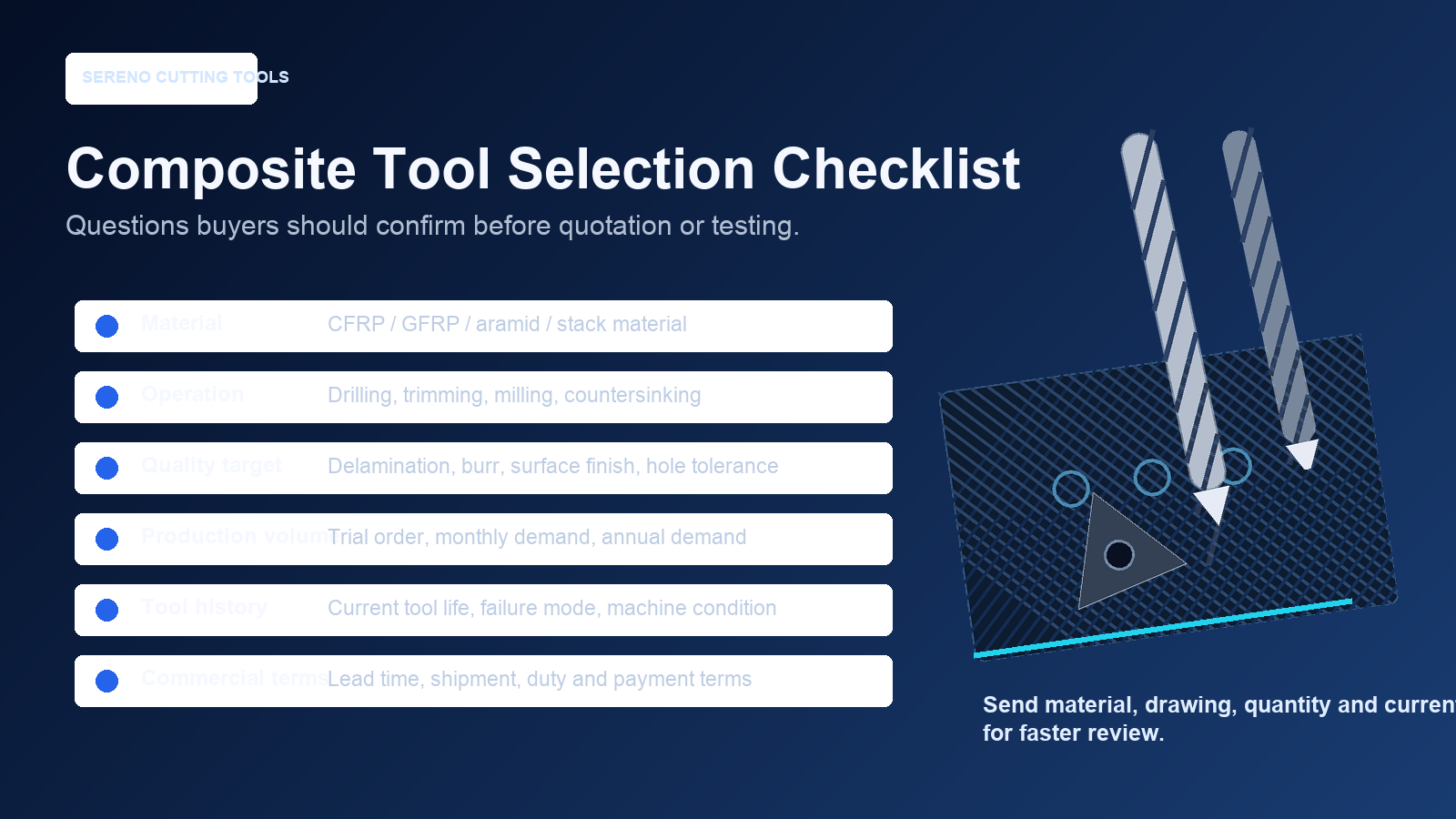
To receive a practical quotation, buyers should prepare clear application information. This helps the supplier avoid recommending a tool that looks correct on paper but fails in real production.
- Composite material type, such as CFRP, GFRP or aramid fiber
- Workpiece structure, including thickness, layup and fiber direction if available
- Machining operation, such as drilling, trimming, routing, milling or countersinking
- Tool diameter, length, shank size and required geometry
- Hole tolerance, surface finish target or edge quality requirement
- Machine type, spindle speed range and tool holder information
- Dry or wet cutting condition, including dust extraction if used
- Current tool life and current machining problem
- Monthly or annual demand
- Drawing, sample photo or existing tool model
If the project is still at the testing stage, buyers can also share the expected testing schedule and production target. This helps build a quotation plan that fits the real project stage.
How to evaluate a composite cutting tool trial
A tool trial should not only check whether the tool can cut the part. A better evaluation compares stability across several parts or batches.
Useful trial points include:
- First-part hole and edge quality
- Quality change after continuous cutting
- Tool wear condition
- Hole size drift
- Delamination or burr level
- Tool change time
- Scrap risk
- Total cost per part
For composite machining, a stable process is often more valuable than the lowest tool price.
Conclusion
Composite machining requires careful tool selection because the material is abrasive, layered and sensitive to process stability. PCD, diamond-coated carbide and solid carbide tools can all be useful, but the best choice depends on material type, operation, production volume and quality target.
If you are sourcing cutting tools for CFRP, GFRP or other composite materials, Sereno Cutting Tools can help review your application details and prepare a practical quotation path.