
Cutting Tool Market Update | August 27, 2026
After a year of sharp tungsten-market movement, carbide tool buyers are asking a different question: if parts of the raw-material market are beginning to stabilize, should purchasing become easier?
The answer is cautiously positive, but not simple. More orderly pricing can help carbide tool suppliers plan production and issue quotations with greater confidence. It does not immediately remove the cost already embedded in tungsten powder, carbide blanks or finished inventory. It also does not eliminate regional price gaps, export controls or long replenishment cycles.
For North American buyers, the practical opportunity is better planning: review inventory, qualify alternatives and compare tools by output instead of reacting only to the latest price change.
This market update uses the latest available information as of August 27, 2026. The newest U.S. cutting-tool shipment dataset covers June 2026, while the tungsten observations cited below include reports through August 25.
What Is Happening in the Cutting Tool Market?
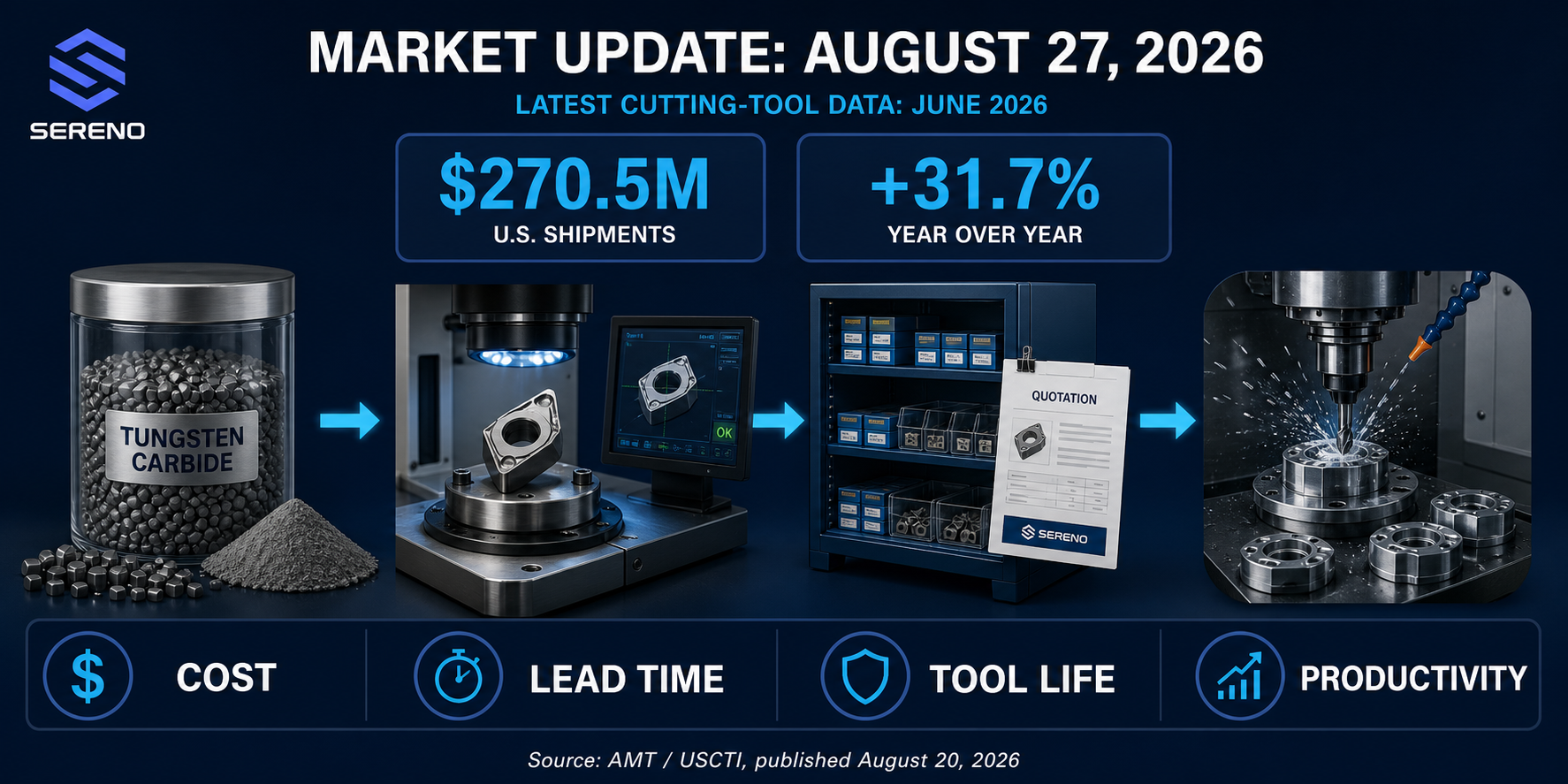
U.S. cutting-tool shipments remained strong through the first half of 2026. AMT and the U.S. Cutting Tool Institute reported June shipments of $270.5 million. That was 12.8% above May 2026 and 31.7% above June 2025. First-half shipments reached $1.47 billion, up 19.3% from the same period in 2025.
Those figures measure shipment value, not pure unit volume. Changes in product mix and selling prices can influence the total. Even with that limitation, the report indicates a commercially active cutting-tool market at a time when manufacturers and customers are still working through high raw-material costs.
Demand conditions vary across aerospace, automotive, general engineering and job-shop machining. A strong headline number therefore does not guarantee immediate availability for every carbide grade, insert geometry or custom tool. Strong downstream activity combined with an expensive, regionally uneven upstream market rewards earlier communication and disciplined sourcing.
Why Tungsten Prices Matter to Carbide Cutting Tools
Most products described as carbide cutting tools use cemented carbide. Tungsten carbide supplies hardness and wear resistance, while a metallic binder helps create a tough, usable cutting material. The finished cost also includes powder preparation, grade formulation, pressing, sintering, precision grinding, coating, inspection and logistics.
That is why a commodity move does not transfer one-for-one into the price of a carbide insert, drill or end mill. Tungsten content is important, but tool size, geometry, coating, manufacturing complexity, order volume and supplier inventory also matter.
The U.S. Geological Survey documented how significantly the upstream market changed before 2026. During 2025, its reported Rotterdam price for 65% tungsten concentrate increased from $266 to $551 per metric ton unit, while ammonium paratungstate, or APT, rose from $331 to $675. USGS estimated China accounted for 79% of world tungsten mine production in 2025.
These historical benchmarks explain why manufacturers entered 2026 with higher replacement costs. Tools delivered today may contain material purchased at different points in that cycle, so suppliers can face different cost positions when quoting the same application.
From Raw-Material Volatility to Relative Stabilization
Recent evidence supports the phrase relative stabilization, not global normalization.
Shanghai Metals Market reported on August 14 that its Chinese 65% tungsten-concentrate assessment was unchanged week over week at RMB 416,500 per metric ton unit. APT was assessed at RMB 605,000 per tonne, down RMB 5,000 week over week, and some cemented-carbide products edged lower. On August 25, SMM reported a producer's late-August APT purchasing offer at RMB 600,000 per tonne, RMB 6,000 below its first-half-August offer, while concentrate offers increased slightly.
These mixed movements suggest that some Chinese tungsten products were consolidating or correcting rather than rising together. They do not show that all tungsten prices had stabilized.
Argus reported a different international picture on August 20. Its duty-unpaid Rotterdam APT assessment declined on August 11 for the first time since April, but remained nearly 500% higher year over year. Argus also reported a large gap between European and Chinese domestic APT indications.
Direction, level and location must be considered separately. A small correction after an exceptional increase can improve sentiment without restoring historical costs. Chinese domestic prices, European import prices and a supplier's replacement cost may move differently.
What This Means for Cutting Tool Buyers
Relative stability can improve purchasing conditions, but benefits usually move through the supply chain with a delay.
- Purchasing cost: Suppliers may still be consuming high-cost tungsten powder, carbide blanks or finished stock. Buyers should ask what period and material position a quotation reflects instead of assuming an immediate price reduction.
- Quotation stability: Less day-to-day volatility may support longer or clearer quotation validity. Confirm the expiration date, quantity basis, delivery terms and any raw-material adjustment condition in writing.
- Inventory planning: Use the calmer period to identify line-stopping tools, standard high-use items and long-lead custom tools. Safety stock should reflect consumption and replenishment risk, not a broad fear of shortages.
- Lead times: Stable prices do not guarantee available material, grinding capacity or coating capacity. Confirm whether quoted lead time starts from order placement, drawing approval or receipt of a deposit.
- Supplier reliability: Compare promised and actual delivery, lot consistency, response time and the supplier's ability to explain substitutions. A low price has limited value if the approved grade is unavailable when production needs it.
- Tool life: Grade, coating, edge geometry and process stability determine how long a tool performs. Raw-material discussion should not replace application review.
- Machining productivity: A dependable tool can reduce changes, offset adjustments, inspection interruptions and scrap. Those effects should be included in the purchasing decision.
This is also a useful time to qualify an alternative supplier. Validation under normal conditions is more reliable than a rushed substitution after stock runs out.
Why the Lowest Tool Price May Not Mean the Lowest Machining Cost
Unit price is visible on every quotation. The cost of lost machine time is less visible, but often more important.
If a lower-priced insert produces fewer acceptable components, requires more indexing and creates greater dimensional variation, a higher-priced but predictable tool may deliver a lower cost per component.
A practical comparison uses four connected measures:
- Tool cost: Purchase price per tool or usable cutting edge, including freight and other delivered costs.
- Tool life: Acceptable components or cutting time achieved before a defined wear, finish or dimensional limit.
- Productivity: Cycle time, tool-change time, machine utilization and the stability of the approved cutting parameters.
- Cost per component: Tool cost plus the machining, labor, inspection, scrap and downtime effects attributable to the tool.
Run comparisons with equivalent material, the same machine and holder condition, consistent coolant, agreed tool-life endpoints and documented speeds and feeds.
For more detailed background on the upstream movement, see Sereno's August 18 market article at /blog/tungsten-carbide-raw-material-prices-2026. Buyers reviewing available tooling can also use the related Carbide Cutting Tools and Carbide CNC Inserts links on this page.
2026 Market Outlook
The remainder of 2026 presents both opportunities and risks. This is not a price forecast.
If tungsten indicators remain more orderly, suppliers may gain better replacement-cost visibility, distributors may refine inventory targets and machine shops may have more time to validate alternatives.
Risks remain. Regional tungsten prices are far apart, China holds a central position in mining and processing, and policy or licensing changes can affect availability. High-cost inventory and renewed demand can also tighten a particular powder, blank, coating or tool category.
Buyers should therefore watch several signals together: AMT/USCTI shipment trends, current supplier lead times, quotation-validity periods, grade availability and regional tungsten reports. No single commodity number describes the complete market for CNC machining tools.
Practical Buyer Checklist
Ask carbide tool suppliers these questions before placing a production order:
- How long is this quotation valid, and what quantity and delivery assumptions does it include?
- Is the quoted carbide grade, blank or finished tool currently available, or will it be produced after order confirmation?
- What is the realistic lead time, and when does the lead-time clock begin?
- How will grade, coating, geometry and dimensional consistency be controlled across repeat orders?
- What application information is needed to compare tool life and cost per component correctly?
- Is there a technically qualified alternative if the preferred item becomes unavailable?
- What forecast, blanket-order or safety-stock arrangement would improve continuity without creating excessive inventory?
Provide the current tool model or drawing, workpiece material and hardness, operation, machine and holder, cutting conditions, present tool life, annual usage and delivery requirement. Better input allows carbide tool suppliers to propose a more relevant commercial and technical path.
Conclusion
Stabilizing tungsten signals can give cutting tool buyers more planning room, but they should not be mistaken for a return to low-cost, low-risk conditions. Earlier increases remain embedded in parts of the supply chain, international prices are still uneven and strong tooling demand can pressure specific products.
The most durable response is to balance purchase price with quotation clarity, delivery reliability, tool life, machining productivity and total cost per component. Sereno Cutting Tools supports distributors and machining companies with carbide cutting tools and carbide CNC inserts based on the buyer's application, quantity and sourcing requirements.
How are raw-material changes affecting your cutting-tool purchasing decisions in 2026? Send Sereno your tool model or drawing, workpiece material, machining conditions, annual demand and target delivery schedule for a practical quotation review.
Sources and Market References
- AMT and USCTI, June 2026 U.S. Cutting Tool Shipments, published August 20, 2026: https://www.amtonline.org/article/june-2026-us-cutting-tool-shipments-totaled-270-5m-up-31-7-from-june-2025
- U.S. Geological Survey, Mineral Commodity Summaries 2026, Tungsten, first posted February 6, 2026 and revised May 27, 2026: https://pubs.usgs.gov/periodicals/mcs2026/mcs2026-tungsten.pdf
- Shanghai Metals Market, Concerns about Tightening Resource Controls Keep Tungsten Prices Resilient in the Off-Season, August 14, 2026: https://news.metal.com/newscontent/104061108-concerns-about-tightening-resource-controls-keep-tungsten-prices-resilient-in-the-off-season
- Shanghai Metals Market, Guangdong Tungsten Industry Raises Concentrate Offers and Lowers APT in Late August, August 25, 2026: https://news.metal.com/newscontent/104078691-guangdong-tungsten-industry-raises-long-term-contract-black-tungsten-and-white-tungsten-prices-lowers-apt-in-late-august
- Argus Media, W Prices Soften but EU Already Hit by Cost Surge, August 20, 2026: https://www.argusmedia.com/en/news-and-insights/latest-market-news/2867542-w-prices-soften-but-eu-already-hit-by-cost-surge